Two panels drawn by the incomparable Mazzucchelli this time. But it’s Miller I want to talk about here. Sometimes I wonder if the reason Miller has become so hard to talk about is because he started to believe that the noir tropes he loves so much are actually real life. Noir undoubtedly made Miller the writer he is; the noir sensibility makes his work distinctive. But maybe if you’re eye-deep in that world for your work, you start to think that life is noir … and then where do you go? Well, self-parody is one option. But his recent Superman story is meant to be good, I think? Is it?
Anyway, let’s talk about the artistry here. I want to spend some time with Born Again – it’s a story I love, and it’s worth dwelling on; there is stuff to learn about and revel in, across a whole spectrum of reading modes (genre stuff, medium-expanding stuff, cultural materialist perspectives, &c., &c.). But small scale artistry to start, blink and you’ll miss them moments:
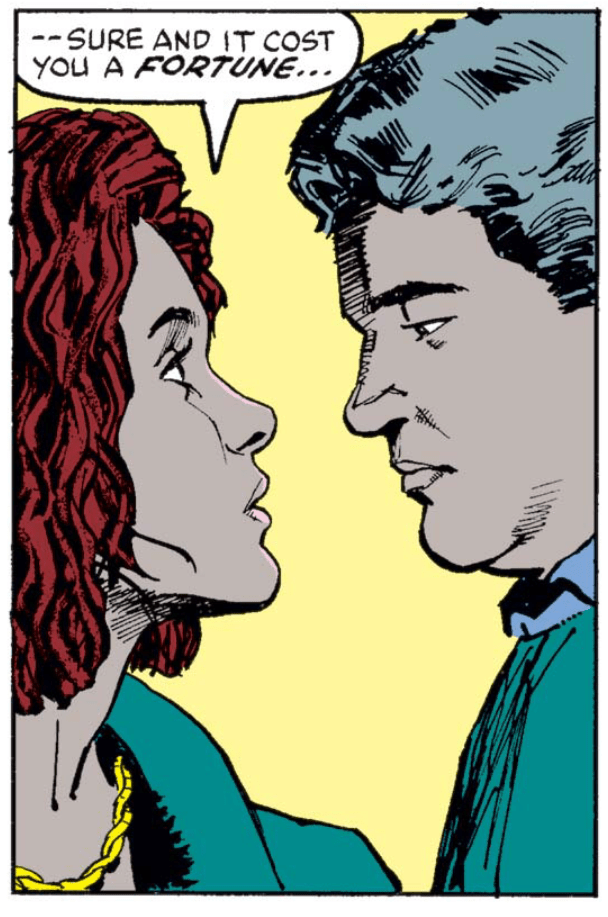
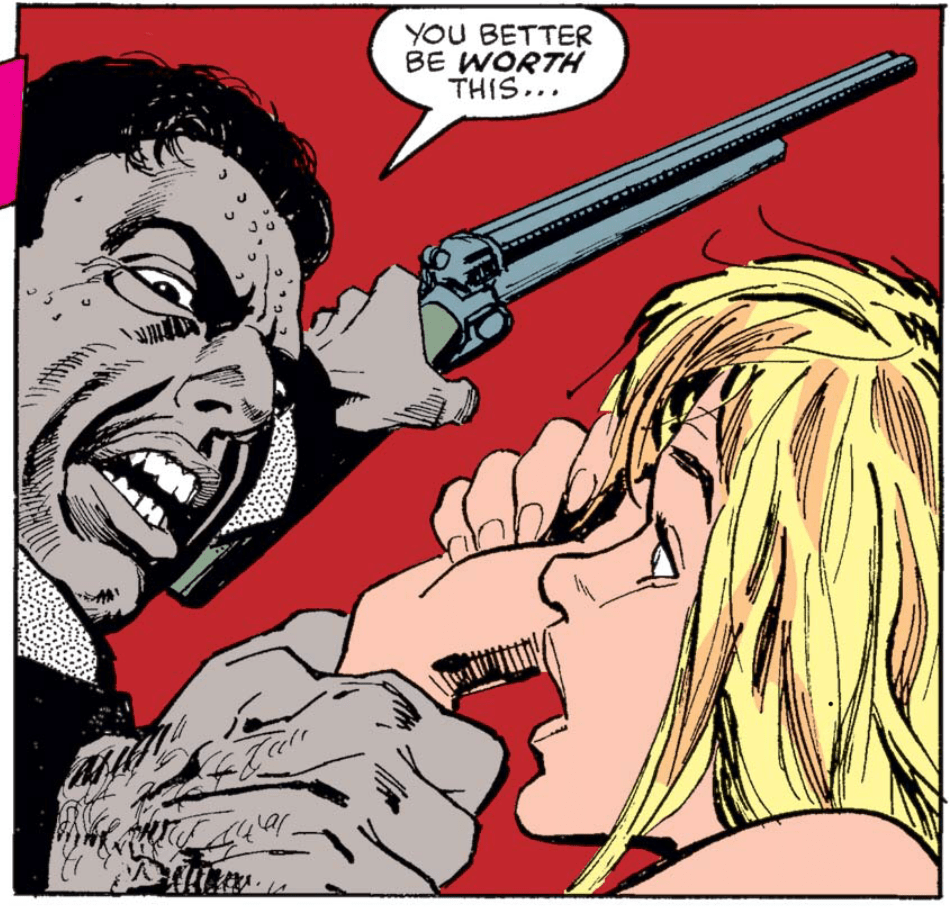
So here we are, in two of the subplots that are interleaved with the story of Murdock versus the Kingpin. In the copy I have (the 1987 Marvel trade paperback – yes, I’m that old skool), these occupy the same space on facing pages, ie the bottom left panel on each page. No idea if it was like this in the individual issues (I have these as well, but they are at my dad’s house in a whole other country) – but who’s to say that the individual issues are the most authentic way to look at it? The 87 TP gives us this visual echo even if the issue doesn’t. The point being: Miller uses the language of value/transactions/worth to make these two scenes counterpoint each other. For Karen, we are at another nadir in a series of nadirs – Paolo kills the Kingpin’s hitmen, but it is quite clear that his payment for a ride to the States is going to be sex, and Karen “had better be worth” it.
(Paolo is very useful for Miller to move plot – he never hesitates to open up with the shotgun, and a couple of issues later kills two cops when it would have been vastly more sensible to hightail it and let discretion be the better part of valour for now.)
For Foggy and Karen, on the other hand, everything is coming up roses – or maybe pearls, or diamonds, or rubies – I dunno, but it must have cost Foggy a fortune. Foggy and Glori have been getting closer and closer over the last few issues, and Foggy’s Christmas present allows the two of them to see how important they have become to each other.
The language of value, transactions, exchange – “worth this” – “cost you a fortune” – and the positioning of each panel at the same place on their respective pages – allows Miller to counterpoint the vastly different fortunes of the subplots’ protagonists.
(There is more to say about this – not least about visual media – not just comics – using “spending a fortune” as a shorthand to depict a male character’s feelings for a female character, and, crucially, the reciprocation of those feelings. But that’s something I’ll get into in another post.)
 Archaeology of the Frivolous - Comics, Culture, Criticism