Well? Did he? We’ve all been wondering since 2016, haven’t we?
Let’s review the evidence.

This guy – I’m not sure this guy even votes. Voting is beneath him. Voting is for the small folk, buffeted by the vagaries of destiny, sustained democracy’s necessary illusions, the pretence that just occasionally, just for the blink of an eye, their lives are not flailing entirely out of control. But this guy – he knows that real power is exercised elsewhere. England expects, gentlemen.

This guy? It could go either way. Maybe, out of some misguided sense of identification with a populist cause, he might just vote for it. He’s been out of touch too long, he’s forgotten his responsibilities. This Brexit business is making a lot of noise. Farage says it’s a revolution for the little people. OK. Maybe I should get behind this.
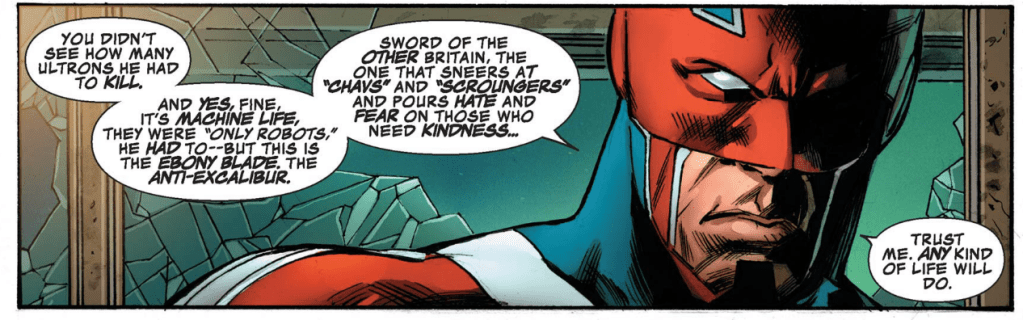
And this guy? Well, of course not. And that would go double for the Captain written by Paul Cornell too. Cornell’s incarnation of Captain Britain redrew his powers so that they waxed and waned with his confidence. A populist mission like Brexit is based on the idea that national power never wanes, unless constrained by the EUSSR (some people actually use that expression). So the Cornell version can be read as an attempt to reconcile being a flag-wearing hero with the idea that a national power is limited (in all sorts of ways – diplomatic, economic, conceptual, ideological. At a conceptual level: to revere one’s nationhood above all things limits you – a necessary and powerful thing for Brian Braddock to represent, from the glamour of his flag).
Now, is there a serious point to be made here, or am I just being even more whimsical than usual? How about this – Voter (or non-voter) no. 1 above comes to us from a Jamie Delano script, and I think that Delano very much takes his cue from the Moore incarnation – that is, an absurd, flag-waving muscle-bound clown with a brain the size of a pea. (I’m paraphrasing Moore a bit here – and I don’t think he ever, in practice, wrote the Captain quite that ludicrously). I wonder if both Moore and Delano couldn’t help but feel ambivalent, at that point in the 80s, about a character wrapped in the Union Jack. The Union Jack was what the Conservative party chose to wrap themselves in too; and the National Front; and in the wake of the Falklands war, had uncomfortable military associations too. The British left has always had a tough time working out how to reconcile internationalist sentiment, popular appeal and national symbols (it has almost never succeeded). So is it any wonder that the Captain was often in this period something of a twit?
The versions written by Ewing (all too briefly) and Cornell (yes, all to briefly too) come after two significant cultural points: the signing of the Maastricht treaty that transformed the European Community into the European Union (1993) and the Cool Britannia period of the mid-90s, during which it felt that an outpouring of art (Damien Hirst, Trainspotting, Britpop) was matched by the resurgence of a now-unstoppable Labour party. Noel Gallagher’s Union Jack guitar, Geri Halliwell’s Union Jack dress. These artefacts harked back to mod aesthetics, of course, so much of a potential nationalist sting was taken out because they felt retro. But something else has happened: being a member of the EU helped with that reconciliation of patriotism and internationalism. The Union Jack was one among many other EU flags, and and the EU had a flag of its own, to boot. National symbols could be symbols of joining, of belonging to a larger community – a way of saying “Yes, we are here too, we also participate.”
What this means is that Cornell and Ewing come to the character when no-one doubts the UK’s future as part of Europe. And there is no need to feel weird or awkward about a character wearing a flag, because that flag is now a symbol of belonging.
So in a way, voters 1 and 2 here dream of becoming voter 3 – a character who can be written sincerely, passionately, open-heartedly, someone who speaks of a nation as belonging and caring.
Next question: Is Captain UK really Irish? (I’m serious; tune in next time, kids.)
 Archaeology of the Frivolous - Comics, Culture, Criticism