We were talking before about one of The Shat’s typically strange choices in this flim, but I’d like to think about TMP a bit more generally now.
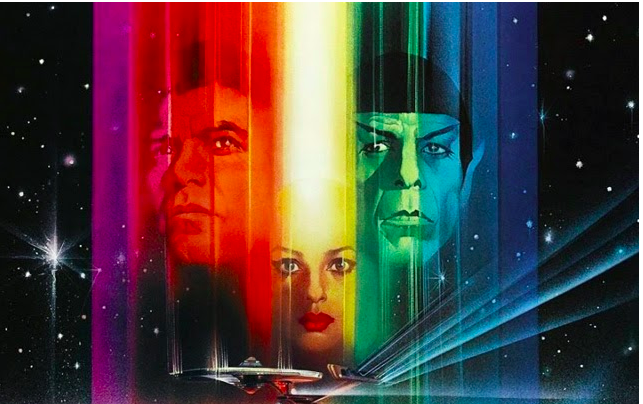
What a weird film TMP is! Even in 1979, who used the phrase “motion picture” anymore? – The grandeur! Sometimes I wonder if this is even Star Trek, strictly speaking – even though it seems to have been commissioned in response to the success of Star Wars, Roddenberry’s real inspiration is 2001. TMP, in its slowness, its ponderousness, wants to say, “Look how serious Star Trek is! Look how serious I, Roddenberry, am! Look upon my works ye mighty and despair, HA HA HA!”
But 2001 is really a kind of visual poem, and Star Trek was always space opera (or space navy), so the glueing of one form onto the other is uneasy, not least because an essential part of Star Trek is its Faith in Humanity. The trippiness of 2001 is a code for evolution – it challenges you to make sense of it because the being for whom it is all obvious – the being for whom it would be space opera – is whoever comes after humanity in its present form. You think something like that is going to happen on Gene’s watch?
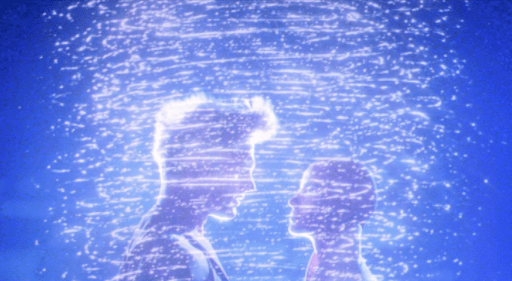
TMP ends with a kind of pulpy depiction of evolution and then comes crashing back to earth – yes, earth. It might look like Decker/V’ger/ilia are/is evolving into something new, a new life or new civilization, but really, this is the most appalling thing Gene can think of. So Kirk immediately neutralizes the concept: the threeway entity of V’ger, Decker and Ilia (there’s nothing wrong with that – this is a sex positive blog) has gained, says Kirk, the human ability to create its own purpose. Of course! It was humanity that was missing all along!
And there, spread across the screen as the titles roll, is Gene’s proud proclamation of his failure to learn from 2001: “The human adventure is just beginning.” So yes, this is Star Trek through and through – and when I try to imagine this strange, fascinating, entertaining failure without Kirk and the gang – with some other crew, knocked together just for this epic – I can’t, of course. Even though it feels like they don’t altogether belong in Gene’s Philosophical Epic. Do I resent it for this? I do not. Just as I am not bored by the slowness of its pace. I love the slowness, because I get to spend more time with these guys; and TMP has a strange kind of depth to it. Some fans like it because it is “philosophical” Trek, i.e. Trek at its highest state of being, its purest form. To that, I say Hmmmm. This film shows that Roddenberry as philosopher is a bust. But this is, nonetheless, a mind trying to work with problems that are beyond it, and this gives the film, I think, a real seriousness. The endgames are trite; but the seriousness and depth comes from the struggle.
 Archaeology of the Frivolous - Comics, Culture, Criticism