Let’s start thinking about Press Gang – still, for my money, Steven Moffat’s most sustained, serious work – by looking at two instances of jokes that are not jokes. These are instances of dialogue that have the rhythm of a joke, but are not the emotional content of a joke. To be more precise – jokes can be complicated and transmit a range of feelings, but generally still make you laugh. The two parajokes I’m looking at here shock you by using the rhythm of the one-liner to do things that aren’t funny. Or are too strange, too uncomfortable, too serious to be only funny.
Both examples are from Monday Tuesday, the penultimate episode of season 1.
The first is a punchline Linda delivers – incredibly, this is how we learn that David Jefford has committed suicide:
COLIN: What kind of a crazy kid puts a loaded shotgun in his mouth? Was it loaded?
LINDA: Not after he pulled the trigger.
It’s worth repeating: we know before this that something very bad has happened – but this punchline is how we find out that David Jefford is dead. It’s wordplay; it’s clever; it makes you want to laugh, to marvel at the quick-wittedness of the writing; and at the same time, there is something horrifying about this narrative turn coming through the device of a punchline.
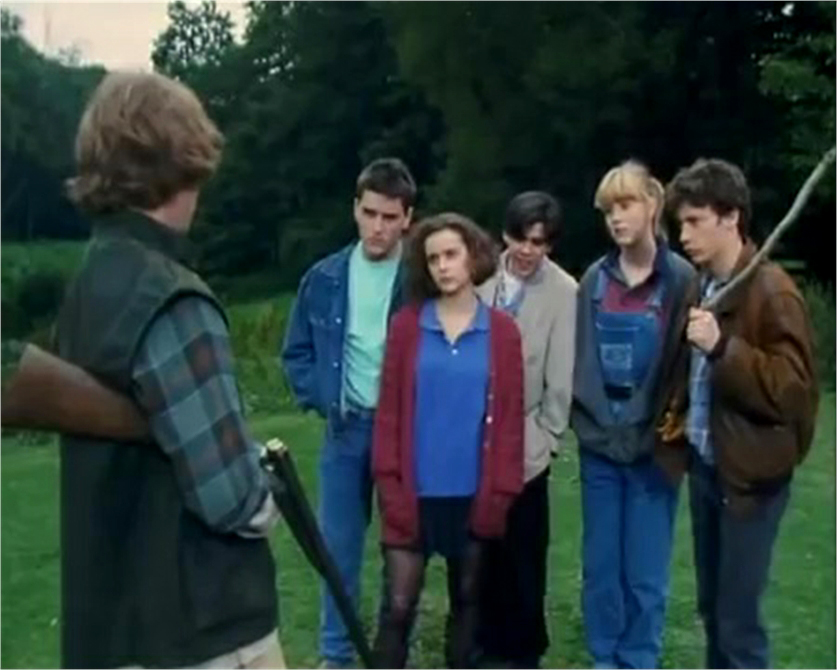
There’s a similar moment in one of the episode’s final bits of dialogue. The narrative track cuts back to Monday, the day of the suicide, and we find Linda and the news team confronting David, telling him that they won’t give in to his blackmail, and that he is an all-round nasty piece of work. They meet him on his father’s estate, and he is carrying a shotgun, to shoot rats, he says. As the team walk away, we hear a gunshot, off-camera, and Spike comments, “He must have bagged a rat.”
At this point in the episode, we know David is dead. I don’t think we’re meant to assume that David shot himself immediately after the confrontation; but the sound of the gunshot materializes his death. It may not be the sound of his death; but it is the same sound as his death. It is the closest the episode gets to depicting it. Which makes Spike’s comment – the second punchline I’m talking about here – all the more horrible. At the sound of the gunshot, Spike quips, “Sounds like he bagged a rat.” And because we, the viewers, occupy a different perspective – we know David is dead, in narrative time – it sounds as though Spike is calling David a rat, even though Spike cannot be doing this, because he can’t know that David, at some point between Monday and Tuesday, will turn the gun on himself.

Unlike us, Spike doesn’t know that David will die later in the episode’s chronological time; so this remark is horrible for us, but not for the characters. Again, the rhythm of the joke creates a moment in the episode where several contradictory feelings come through all at once. We can’t condemn Spike for this callous joke because it is callous for us and not for him. But we are nonetheless expected to recoil, to feel horror at this bit of wordplay, which can only mean, really, to feel horror at Moffat himself for writing this quip, for making us feel exactly what we feel here.
Timothy Clarke, in Ecocriticism on the Edge, comments on the capacity of criticism, thought, philosophy to seek connections and patterns and in so doing make things smooth, intelligible through patterning and pattern seeking. And by doing this we might miss things; sometimes discjuncture might be more important. So I hazard the next observation a bit cautiously:
Monday Tuesday, if I remember this right, is Moffat’s first experiment with narrative time, with reordering the chronological sequence of a story for (let’s say) aesthetic effect. What I want to suggest here is that these two jokes, or parajokes, are a smaller, sentence-level instance of the same impulse. Just as the episode’s structure aestheticises a disruption of narrative expectations, these two parajokes interrupt our expectation of the structure of a joke (ie, that it should make us laugh – rather than gasp, or recoil, or freeze).
Too neat, no? That’s what the pattern-making urge does. We can say there are echoes here, between the micro and macro. But I don’t think that Moffat planned it – a first time writer, 25 years old, cranking out twelve scripts per season? I don’t think you have the bandwidth for it. But I’m a death of the author guy from way back – does it matter what Moff intended?
I suppose there are different ways of attending to the “truth” of artistic production at 4:45 on Children’s ITV, in the deepest heart of 1989. Part of that is to say that death of the author gets you one version of the events (an intricate, echo-woven experience). But the other is important too – as I said earlier, I still think Press Gang is Moffat’s most serious work, and these jokes are part of that. It doesn’t matter whether they echo other elements of the episode – they are the work of a writer of such seriousness, such intent, that when depicting the suicide of a teenager he bends even the structure of his jokes to reflect the horror, to put the viewer in the position of “What do I do with this? How do I react?”
 Archaeology of the Frivolous - Comics, Culture, Criticism