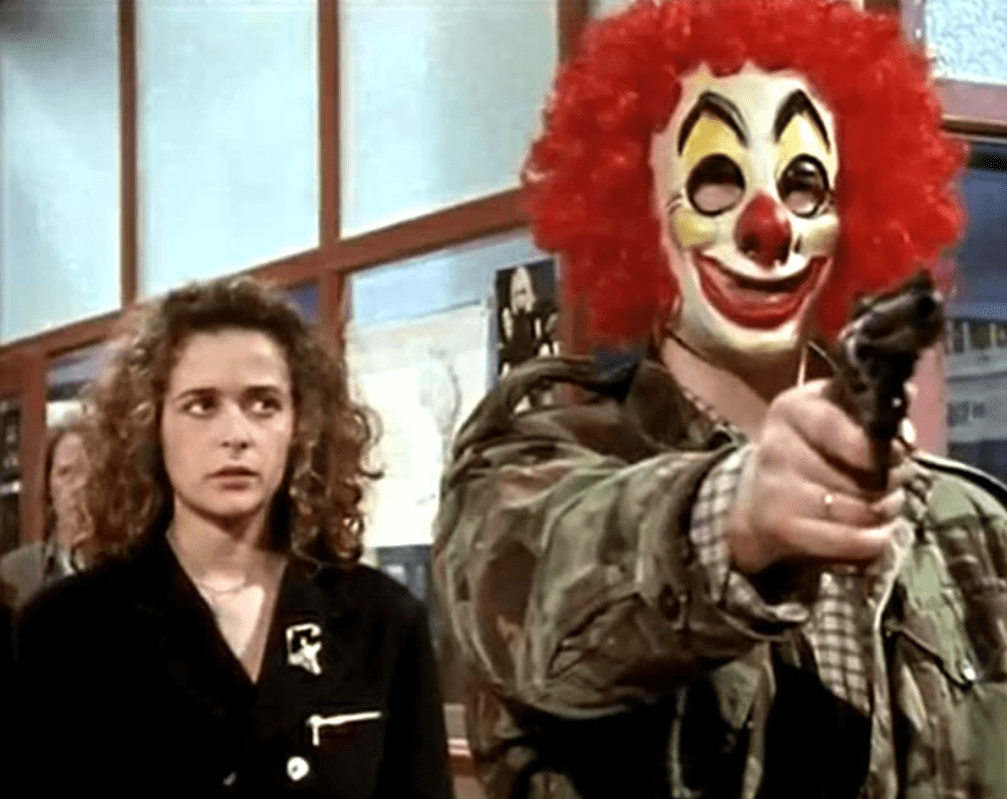
A tic in pop criticism that I find aggravating is when a writer says that Show X or Book Y “deals with the topic of …” This promises that Show X or Book Y proceeds somehow from an analysis of the topic; that the topic is not just a Thing in the Story. But the writer of this kind of criticism almost never actually explains why the topic is “dealt with” rather than merely being the occasion of the story. Hence the Wikipedia page for Press Gang, which tells us that the show “tackles” the topic of “firearms control.”
Does it, though? Really?
Make no mistake: The Last Word Parts 1 and 2 is solid gold, high watermark Press Gang. Everyone is firing on all cylinders here. Moffat is at his craftiest, using two frame narratives (one per episode) to show that a Junior Gazette staffer has died in the siege – and giving us two shots fired, to make us think that first Colin and then Spike may have died. The get-out is tremendous – of course Lynda will follow through on her promise, even though Donald Cooper is dead. And of course she is thinking it through, putting the plan in place, even though Spike has just witnessed his death and is freaking the math out. Her word is absolute. Which sometimes makes her a tyrant; but also sometimes makes her incredibly decent and humane – as when she tells David Jefford, after his blackmail attempt, that he is welcome back on the Junior Gazette, she will forget the blackmail attempt ever happened. (Counter-reading: Lynda is at her steeliest, and she has more chance of beating the odds if David thinks he can come back.)
But is any of this “tackling” the issue of firearms control? Better: was firearms control any kind of issue in the UK in the early 90s? A few years after this episode, the UK’s only school shooting took place in Dunblane, and the (Conservative) government’s totally uncontroversial response was to ban handguns. Rather than saying this episode “tackled” an issue, we might be better off seeing a pattern: that in Press Gang, there are only two episodes (I think) in which guns are used as part of the narrative. In both instances they are fired by lonely boys who seem to have problems with their families (Donald Cooper says that his mother might notice him, as a result of the siege). And crucially, the guns are used for suicide. If anything, even two instances of this pattern seems like quite a high incidence of gun suicide among teenagers for Lynda and the gang to encounter; if anything, this pattern seems to be telling us that you may never be standing far away from someone who is far more desperate than they appear.
 Archaeology of the Frivolous - Comics, Culture, Criticism